


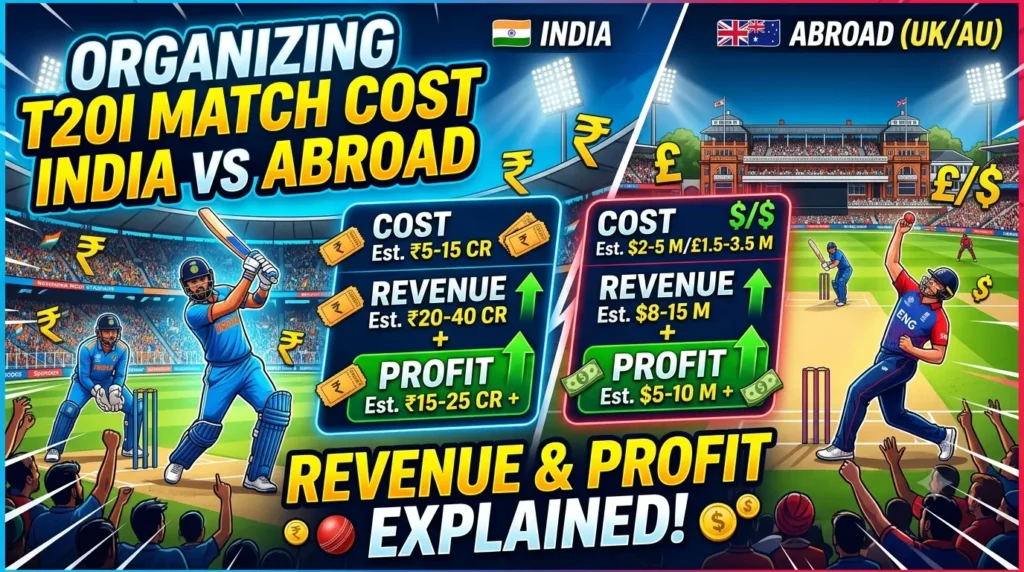
T20I Match Cost in India vs Abroad , Revenue Profit
A T20I cricket match lasts around three hours, but organising it involves major expenses, including stadium arrangements, security, staff and team facilities. At the same time, match organisers can generate revenue through ticket sales, sponsorships and broadcasting deals. But how much does a match actually cost, how much revenue can it generate, and what profit remains after expenses? Let’s compare the estimated costs and earnings of T20I matches in India and abroad.
The financial picture can also change depending on where the match takes place. A regular bilateral T20I in India may have a different cost structure from a match hosted in England, Australia or the UAE. ICC tournament matches can follow another commercial model altogether.
Cost to Organise a T20I Match in India
Organising a T20 International (T20I) cricket match in India involves several expenses beyond the game itself. The total cost depends on the stadium, match arrangements, security requirements and agreements between the cricket board and the host association.
Stadium and Ground Preparation: The venue must be ready for international cricket, including pitch preparation, outfield maintenance, floodlights, dressing rooms and spectator facilities. Cleaning, electricity and temporary arrangements can add to the expenses.
Security and Crowd Management: Police deployment, private security, entry checks, fire safety and crowd control are essential. The cost can increase for high-profile matches that attract large crowds.
Staff and Match Operations: Organisers need ground staff, event managers, ticketing teams, scorers, medical personnel and other support workers. Food and hospitality arrangements for players, officials and guests may also be included.
Travel and Accommodation: Depending on the hosting agreement, expenses may include local transport, hotel stays, team logistics and arrangements for match officials. Some costs may be covered separately by the cricket board or visiting teams.
Broadcasting and Other Arrangements: Camera facilities, communication systems, electronic scoreboards and additional equipment may be required, although the broadcaster may pay for some production costs independently.
For context, the Madhya Pradesh Cricket Association’s published accounts for the India–Afghanistan T20I held in Indore on January 14, 2024, list expenses including ₹25.81 lakh for gate control, ₹19.22 lakh for the police welfare fund, ₹15.10 lakh for ground and stadium expenses, and ₹12.95 lakh for floodlight operations. These are individual expense items, not the total cost of the match.
Therefore, the total cost of hosting a T20I cannot be determined from stadium rent alone. It depends on the expenses actually borne by the organiser and the financial arrangements with the cricket board, venue and broadcasting partners.
Cost of organizing a T20 match in abroad
Hosting a T20I cricket match in a foreign country can involve significant expenses, depending on the stadium, local conditions and hosting agreements. Organisers may need to pay for stadium rental, pitch preparation, floodlights, security, cleaning and spectator facilities. The cost of these arrangements varies from country to country.
Travel and Accommodation: If a team travels overseas, expenses may include flights, hotels, local transport, meals and practice facilities. However, these costs may be shared between cricket boards or covered under separate agreements.
Security and Local Staff: Police arrangements, private security, medical services, event managers and ground staff are essential for managing players and spectators. Local labour costs and security requirements can affect the overall budget.
Broadcasting and Event Operations: International matches require cameras, communication equipment, scoreboards and technical teams. Some broadcasting expenses may be paid directly by the broadcaster rather than the match organiser.
A useful historical example comes from the BCCI’s audited accounts for the 2021 ICC Men’s T20 World Cup. The tournament’s reported expenses included ₹62.47 crore for hosting and staging costs paid to foreign cricket boards, ₹3.76 crore for security and ₹5.67 crore for travel. These figures cover the tournament, not one match.
Therefore, hosting a T20I abroad does not automatically cost more than hosting one in India. The final cost depends on the venue, local prices, travel requirements and the agreement between the cricket boards.

How Does a T20I Match Generate Revenue?
A T20I cricket match generates revenue from several sources. Ticket sales bring income from spectators, while sponsors pay to promote their brands through stadium advertising and official partnerships. Broadcasting rights can be another major source of income, as television channels and streaming platforms pay to show matches. Premium seating, corporate boxes and hospitality packages can generate additional revenue. However, the money is distributed according to agreements between cricket boards, broadcasters, stadium operators and commercial partners.
Estimated Revenue From One T20I Match in India vs Abroad
The revenue from a T20I match depends on the teams playing, audience size, ticket prices and commercial agreements. A match featuring India can attract strong advertising and broadcasting interest, but its total revenue cannot be calculated from ticket sales alone. Foreign-hosted matches may earn money through local ticket sales, sponsorships and broadcasting contracts. For example, BCCI’s audited accounts recorded ₹34.20 crore in media-rights income and ₹13.87 crore in ticket income for two T20 matches hosted in Florida in 2016. These are historical figures for two matches combined, not current revenue estimates for one match. <Cite refs={[”
Profit Left After All Expenses
The profit from a T20I match depends on how much revenue the organiser receives and how much it spends on hosting the event. Expenses can include stadium arrangements, security, staff, travel, accommodation and other operational costs. For example, if an organiser receives ₹5 crore in attributable revenue and spends ₹3 crore on attributable expenses, the operating surplus would be ₹2 crore. This is only a hypothetical calculation, not an actual T20I profit figure. The final profit may be lower after additional overheads and contractual payments. Actual earnings vary by match and hosting agreement.
India vs Abroad: Complete Cost, Revenue and Profit Comparison
The cost and revenue of a T20I match can vary depending on the venue, audience, sponsorship deals and hosting arrangements. The following table uses hypothetical figures to explain how the financial model works. These are not verified average earnings for an actual match.
| Financial Item | India (Example) | Abroad (Example) |
|---|---|---|
| Estimated revenue | ₹5 crore | ₹4 crore |
| Estimated hosting expenses | ₹3 crore | ₹2.8 crore |
| Operating surplus | ₹2 crore | ₹1.2 crore |
In this example, the Indian match generates more revenue and leaves a higher operating surplus. However, the result could be different for another match. A popular overseas venue may attract strong ticket sales and sponsorships, while an Indian match with lower attendance could earn less than expected.
These figures are only for illustration. Actual costs and revenue depend on the agreements between cricket boards, broadcasters, sponsors and stadium operators. Operating surplus is also not necessarily the final net profit, as additional overheads and contractual payments may still need to be deducted.
Who Earns the Money From a T20I Match?
The revenue generated by a T20I match may be shared among several organisations, depending on their commercial agreements.
Cricket Board: The organising board may earn money from broadcasting rights, sponsorship agreements and other commercial arrangements. It may also pay for certain match-related expenses.
Stadium Operator or Cricket Association: The venue owner or host association may receive stadium rental, hosting payments, ticketing income or a share of other revenue, depending on the agreement.
Broadcaster: Television channels and streaming platforms pay for broadcasting rights. They may generate revenue through advertising, subscriptions and commercial partnerships, while also bearing production costs.
Sponsors: Companies pay to promote their brands through advertising boards, official sponsorships and other marketing opportunities. They receive brand visibility rather than a direct share of ticket revenue in every case.
The key point is that the organisation receiving the money is not always the organisation keeping the profit. Each party’s final earnings depend on its revenue rights, expenses and contractual obligations.
Frequently Asked Questions
1. Does Every T20I Match Make a Profit?
No, not every T20I match makes a profit. Earnings depend on ticket sales, sponsorships, broadcasting agreements and hosting expenses. If the total revenue is lower than the expenses, the organiser may face a loss.
2. What Is the Biggest Source of Revenue From a T20I Match?
Broadcasting rights and sponsorships can be major revenue sources, especially for matches involving popular teams such as India. Ticket sales and hospitality packages also contribute to earnings. The largest source depends on the commercial agreements and the match being organised.
3. Is Hosting a T20I Match Abroad More Expensive Than in India?
Not always. Foreign matches may involve higher travel, accommodation or venue costs, but expenses vary by country and stadium. The final cost depends on local prices, security requirements and agreements between cricket boards.
4. How Is Profit Calculated From a T20I Match?
Profit is calculated by subtracting the expenses attributable to the match from its revenue. However, the final net profit may also depend on administrative costs, contractual payments and other financial obligations.
5. Who Receives the Revenue From a T20I Match?
Revenue may go to cricket boards, host associations, stadium operators and commercial partners according to their agreements. The organisation that collects revenue does not necessarily keep all of it as profit.
Hosting a T20I Match Profitable Business
Hosting a T20I match can be profitable, but the final result depends on ticket sales, sponsorships, broadcasting revenue and total expenses. India may generate higher revenue because of its large cricket audience and strong commercial market, while hosting costs and revenue opportunities vary in other countries.
For example, if a match generates ₹5 crore in attributable revenue and costs ₹3 crore to organise, the estimated operating surplus would be ₹2 crore. This is an illustrative example, not the confirmed profit of an actual match.
The key takeaway is that a T20I match is not automatically profitable. The host cricket board or association must compare its actual revenue with all relevant expenses and contractual payments to understand how much money it earns.
Disclaimer: The cost, revenue and profit figures mentioned in this article are approximate estimates for informational purposes only. Actual figures may vary depending on the venue, country, sponsorships, broadcasting deals and match expenses. Illustrative calculations should not be treated as verified financial results.