









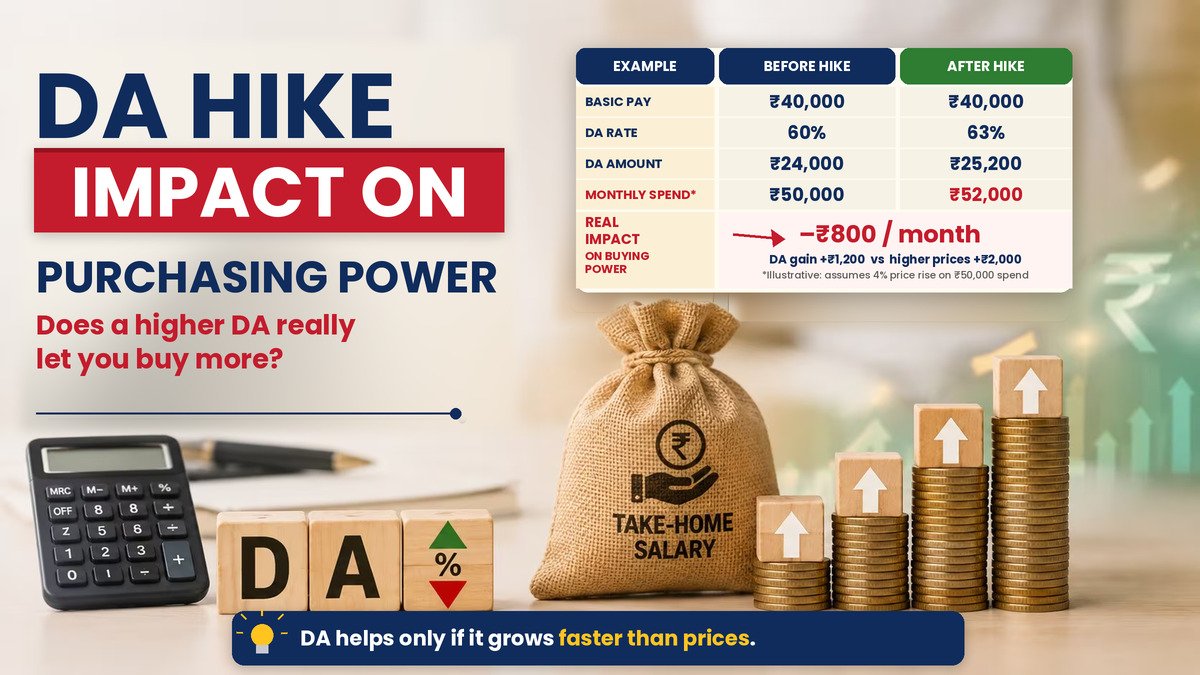
The 3% DA hike offers additional income to central government employees, but does it really improve their purchasing power? This article examines the relationship between salary growth and inflation, explaining how rising food, housing and healthcare expenses can reduce the actual financial benefit. It also highlights the difference between higher nominal income and real financial improvement.
3% DA hike impact on Purchasing Power of Government Employees?
A salary increase usually brings relief, but does it always make a household financially stronger? This is an important question following the Central Government’s latest 3% Dearness Allowance (DA) hike. Although employees will receive additional money every month, the actual benefit depends on how much their regular expenses have increased.
The government has raised DA from 60% to 63% of basic pay, effective July 1, 2026. The revision is intended to provide relief against rising prices. However, an increase in salary and an improvement in purchasing power are two different things. An employee may receive more money in their bank account but still find it difficult to save if essential expenses are rising at a similar or faster pace.
Why a 3% DA Hike May Not Feel Like a 3% Financial Improvement
To understand the difference, consider an employee with a basic salary of ₹35,000. Under the previous 60% DA rate, the employee received ₹21,000 as DA. With the revised 63% rate, this amount increases to ₹22,050. The additional monthly income is ₹1,050.
On paper, this is a positive salary adjustment. But the real question begins when this additional money meets everyday expenses.
Consider a household spending money on groceries, rent, electricity, transportation, education and healthcare. If grocery prices increase, medical expenses rise or rent becomes more expensive, the additional DA may gradually get absorbed into the monthly budget.
For example, if an employee receives ₹1,050 extra but experiences an additional ₹800 in monthly household expenses, only ₹250 remains as additional financial flexibility. This is a hypothetical illustration, not an estimate of actual inflation or an individual’s expenses.
Official inflation data also shows why looking at one overall inflation number can be misleading. According to the Ministry of Statistics and Programme Implementation, India’s retail inflation stood at 5.54% in September 2026, while food inflation was higher at 7.74%. Housing inflation was 2.74% and healthcare inflation was 1.40%.
These figures represent different categories of consumer prices. Every household has a different spending pattern, so the impact of inflation is not identical for all employees.
Another important point is that the DA revision and headline retail inflation are not calculated using the same index. DA adjustments follow the applicable formula based on the Consumer Price Index for Industrial Workers (CPI-IW), whereas general retail inflation is measured through the Consumer Price Index (CPI). Therefore, directly comparing a 3-percentage-point DA increase with 5.54% retail inflation does not provide a complete picture of an employee’s real income.

What Should Employees Actually Look at: Salary Growth or Purchasing Power?
The more useful way to evaluate a DA hike is to examine how much additional money remains after meeting regular expenses.
There are three important factors employees should consider.
First, monthly savings matter more than the salary increase alone. If additional income is entirely spent on groceries, bills and other necessities, the employee may not experience a meaningful improvement in financial security.
Second, household inflation can be different from national inflation. A family spending a large portion of its income on food and education may experience a different cost increase from a household whose major expenses are rent, transportation or healthcare.
Third, regular salary increases should be considered alongside long-term financial planning. Employees can use additional DA income to strengthen emergency savings, reduce expensive debt or meet essential financial commitments instead of automatically increasing discretionary spending.
The distinction between nominal income and real income is particularly important here. Nominal income refers to the actual money received, while real income reflects what that money can purchase after considering changes in prices. If income rises but the cost of living also increases, the improvement in purchasing power may be limited.
The Bigger Picture
The 3% DA hike provides additional financial support to central government employees and pensioners, but its real value cannot be measured by the revised percentage alone. What matters is how the increase compares with an individual’s actual expenses and savings.
A higher salary is certainly useful, but stronger purchasing power comes when income grows sufficiently to meet rising costs while leaving room for savings. That is the difference employees should focus on when evaluating the real benefit of the latest DA revision.




2 thoughts on “DA hike impact on purchasing power, Are Government Employees Actually Better Off ?”