









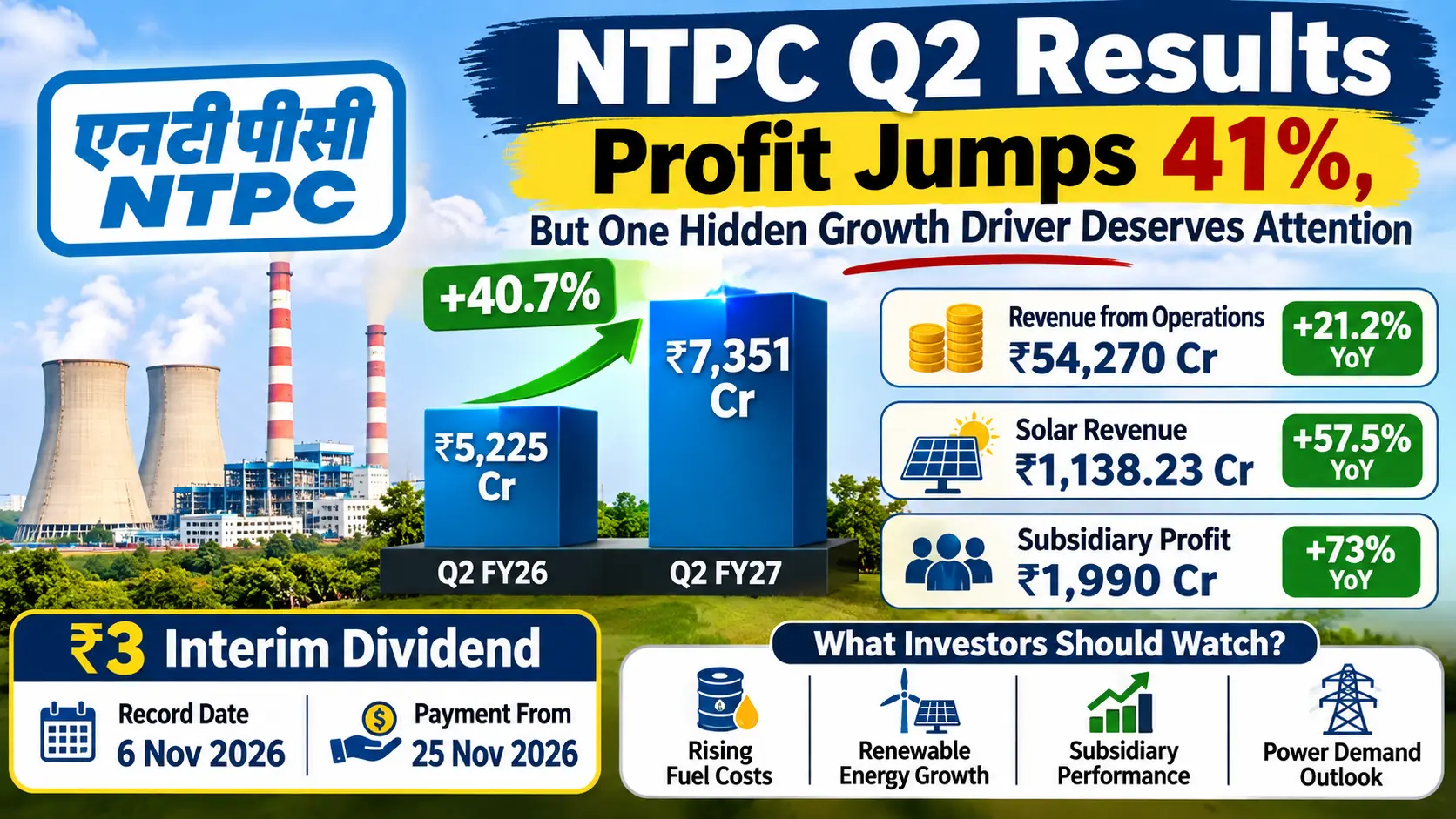
NTPC share price after NTPC Q2 Profit Jumps 41% in this quarter,The growth in consolidated profit was supported by a 73% increase in profits from subsidiary companies, which rose to Rs 1,990 crore in Q2 FY27 from Rs 1,149 crore in the year-ago period, NTPC said in its press release.
NTPC Share Price after Q2 Results,Profit Jumps 41%, But One Hidden Growth Driver Deserves Investors’ Attention
India’s largest power generation company, NTPC Limited, has reported a strong financial performance for the second quarter of FY27. The company’s consolidated profit increased by around 41% year-on-year to ₹7,351 crore, while revenue from operations grew 21.2% to ₹54,270 crore. Along with its quarterly results, the company also announced its first interim dividend of FY27 at ₹3 per equity share.
However, there is more to this result than higher profit and a dividend announcement. A closer look at NTPC’s financial statements reveals that its subsidiary businesses, renewable energy operations and power plant efficiency are also playing an important role in its growth.
NTPC Q2 Results: What Do the Financial Numbers Show?
For the July-September quarter of FY27, NTPC reported consolidated profit of ₹7,351 crore compared with ₹5,225 crore in the same quarter last year. Revenue from operations increased from ₹44,784 crore to ₹54,270 crore.One important detail is the difference between standalone and consolidated performance. NTPC’s standalone profit increased by 14.3% to ₹5,320 crore, whereas consolidated profit grew by 40.7%.This difference deserves attention because it shows that the growth is not coming only from NTPC’s parent company operations.
The profit contribution from subsidiary companies increased approximately 73% to ₹1,990 crore from ₹1,149 crore in the corresponding quarter last year.For investors, this is an important development. It indicates that NTPC’s wider business group is contributing more significantly to its overall earnings. However, investors should also track whether this contribution can remain strong in coming quarters.
It is also important to understand that the reported consolidated profit of ₹7,351 crore includes the share belonging to non-controlling interests. The profit attributable to NTPC’s shareholders was approximately ₹7,030 crore.
 The Hidden Story: Renewable Energy and Power Generation Efficiency
 The Hidden Story: Renewable Energy and Power Generation Efficiency
NTPC is traditionally known for its large coal-based power generation business. However, its latest financial performance also highlights the growing contribution of renewable energy.
According to the quarterly financial statements, revenue from solar power stations increased to ₹1,138.23 crore from ₹722.52 crore in the same quarter last year. This represents growth of around 57.5%.This development is worth watching because India’s electricity requirements are increasing, while power companies are also expanding their renewable energy capacity.Another important indicator is Plant Load Factor (PLF), which measures how efficiently a power plant uses its available generation capacity.
NTPC’s coal-based power stations recorded a PLF of 75.11% during the first half of FY27. In comparison, the average PLF of coal-based power stations across the rest of India was 68.35%.A higher PLF indicates better utilisation of available generation capacity. For a large power producer, efficient utilisation can support electricity generation and revenueNTPC is also moving towards energy storage. Its official announcements include the commercial operation of a 250 MW/500 MWh battery energy storage project through NVVN on October 29, 2026.Battery storage is important because solar and wind power generation can change depending on weather conditions. Storage systems can help supply electricity when renewable generation is not available at the same level.These developments suggest that NTPC’s future business will not depend only on conventional electricity generation.
Rising Fuel Costs: A Number Investors Should Not Ignore
Despite strong revenue and profit growth, there is another side of the results that deserves attention.NTPC’s consolidated fuel cost increased to approximately ₹28,628 crore in Q2 FY27 from ₹23,062 crore in the year-ago quarter.This is an important factor because fuel is one of the major operating expenses for a power generation company.
Higher fuel costs do not automatically mean weaker profitability, but investors should monitor how efficiently the company manages these expenses and whether revenue growth continues to cover rising costs.In the coming quarters, fuel availability, electricity demand, plant utilisation and operating expenses will remain important factors for NTPC’s financial performance.

NTPC ₹3 Interim Dividend: Record Date and Investor Calculation
NTPC’s board declared its first interim dividend for FY27 at ₹3 per equity share with a face value of ₹10.The company has fixed November 6, 2026, as the record date. Dividend payments are scheduled to commence from November 25, 2026 onwards.For example, an investor holding 100 eligible NTPC shares would receive a gross dividend of ₹300. An investor holding 500 shares would receive ₹1,500 before applicable taxes.
However, dividend amount and dividend yield are two different things. Dividend yield depends on the market price of the share. Therefore, investors should not consider a ₹3 dividend alone as a reason to purchase the stock.NTPC’s Q2 performance highlights growth in consolidated earnings, stronger subsidiary contributions and increasing revenue from solar power operations. At the same time, rising fuel costs remain an important factor to monitor.Investors should keep an eye on three things in the coming quarters: the profitability of subsidiary businesses, the expansion of renewable energy projects and the company’s ability to manage fuel expenses.
Overall, NTPC’s latest results show that its growth story is becoming broader than traditional power generation. However, whether this performance can continue will depend on future earnings, operating costs, project execution and the company’s ability to maintain efficient power generation.