

RBI Repo Rate 2026 Increase : Latest Rate at 5.50%, Impact on EMIs, Home Loans and FD Rates
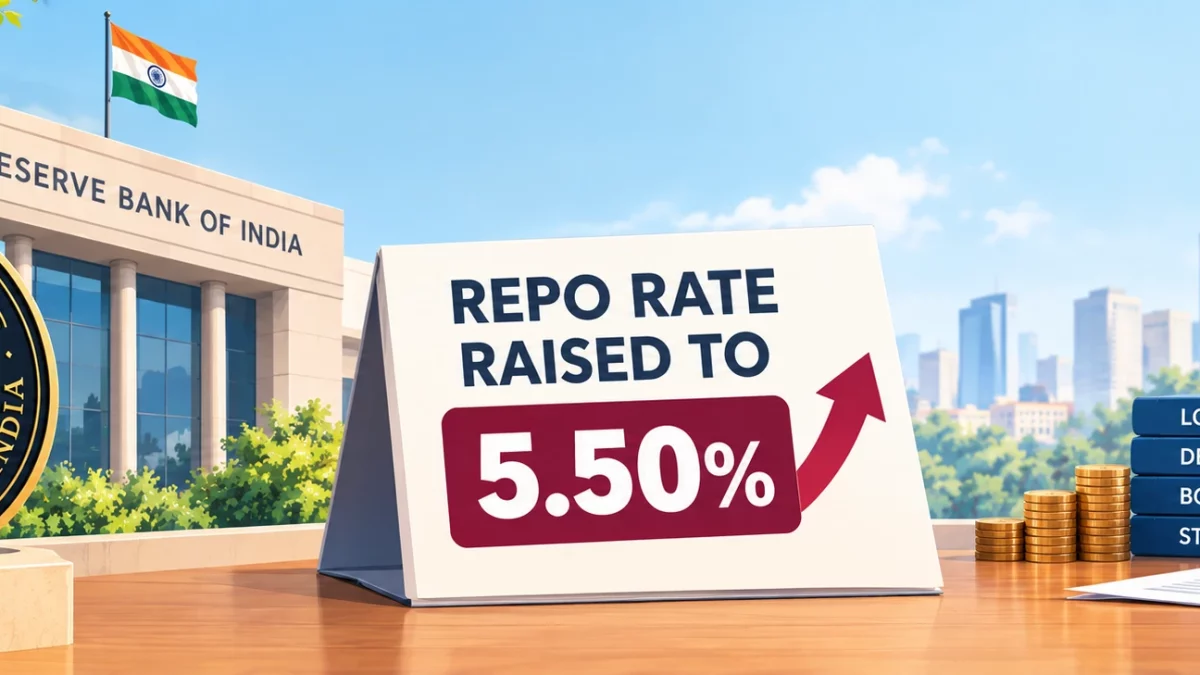
The Reserve Bank of India (RBI) raised its policy repo rate by 25 basis points to 5.50% on October 7, 2026, from the previous rate of 5.25%. The decision came as the central bank responded to rising inflation risks and uncertainty in the global economy. The RBI also changed its monetary policy stance from “neutral” to “calibrated tightening.”
The latest decision is important for borrowers, savers, businesses and investors because changes in the repo rate can influence borrowing costs, bank lending rates, fixed deposit returns and financial market sentiment. However, the actual impact depends on how banks adjust their rates and how the economy develops.
In this article, FinGossip explains what the repo rate is, why the RBI raised it, and what the latest decision could mean for home loan EMIs, personal loans, fixed deposits and the Indian economy.
What Is the RBI Repo Rate?
The repo rate is the policy interest rate at which the Reserve Bank of India provides eligible short-term funds to banks against eligible securities under the applicable liquidity framework.
In simple terms, the repo rate is one of the main tools the RBI uses to influence interest rates and manage inflation in the economy.
When inflationary pressures increase, the RBI may raise the repo rate to make borrowing conditions tighter. Higher interest rates can reduce some types of spending and credit demand over time, helping to control inflation.
When inflation is under control and economic conditions require support, the central bank may reduce the repo rate to make borrowing conditions more supportive.
However, the repo rate does not directly determine every loan or deposit rate. Banks consider funding costs, competition, credit risk and their own lending policies when setting interest rates. RBI Repo rate 2026 increase
What Is the Latest RBI Repo Rate in October 2026 ?
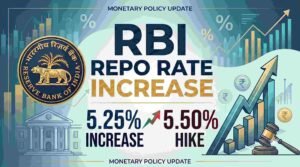
The RBI announced its latest monetary policy decision on October 7, 2026. The Monetary Policy Committee (MPC) voted unanimously to increase the policy repo rate by 25 basis points. RBI Repo rate 2026 increase
Here are the key details of the October 2026 decision:
| Policy indicator | Latest position |
|---|---|
| Current repo rate | 5.50% |
| Previous repo rate | 5.25% |
| Rate change | Increase of 0.25 percentage point |
| Announcement date | October 7, 2026 |
| Policy stance | Calibrated tightening |
| GDP growth projection for FY2026–27 | 7.1% |
| CPI inflation projection for FY2026–27 | 5.2% |
The growth and inflation figures are the RBI’s projections, not guaranteed outcomes. Economic conditions can change, and the projections may be revised in future policy reviews.
The repo rate increase was the RBI’s first such increase since February 2023, according to Reuters. The central bank indicated that future decisions would depend on inflation, economic growth and the overall outlook.
Source: RBI official website
Why Did the RBI Increase the Repo Rate?
The RBI considers several economic indicators before changing its policy rate. The October 2026 decision reflected concerns about inflation and the changing global economic environment.
1. Rising Inflation Risks
Inflation refers to a sustained increase in the prices of goods and services. When prices rise quickly, households may find it harder to manage their everyday expenses.
Higher inflation can reduce purchasing power and create uncertainty for businesses. By raising interest rates, the RBI aims to prevent price pressures from becoming more widespread and persistent.
2. Higher Crude Oil Prices
India imports a substantial share of its crude oil requirements. When global oil prices rise, fuel, transportation and production costs can increase.
Businesses may pass some of these additional costs on to consumers, contributing to inflation. Oil prices therefore remain an important factor in the RBI’s assessment of economic conditions.
3. Global Economic Uncertainty
Geopolitical tensions, changes in global interest rates and movements in international commodity prices can affect India’s inflation outlook and financial markets.
The RBI has to consider these external risks while balancing domestic economic growth and price stability. RBI Repo rate 2026 increase
4. The Need to Manage Inflation Expectations
If households and businesses expect prices to continue rising, workers may seek higher wages and companies may increase prices more frequently.
The central bank uses monetary policy to help keep inflation expectations under control. Interest rate changes can influence economic behaviour, although their full effects often take time to appear.
How Does a Repo Rate Increase Affect Home Loan EMIs?
Home loan borrowers are among those who may pay attention to repo rate changes, particularly if their loans have floating interest rates linked to an external benchmark.
When the benchmark rate increases, a bank may raise the applicable lending rate according to the terms of the loan. This can increase the monthly EMI, extend the repayment period or lead to a combination of both.
However, the impact is not always immediate. The timing depends on the loan agreement, benchmark and reset schedule.RBI Repo rate 2026 increase
Example: How a Higher Interest Rate Could Affect a Home Loan
Consider an illustrative home loan of ₹30 lakh with a remaining repayment period of 20 years.
If the applicable annual interest rate were 8.5%, the approximate EMI would be ₹26,035. If the interest rate increased to 8.75%, with the loan amount and remaining tenure unchanged, the approximate EMI would rise to ₹26,524.
| Illustrative loan detail | Amount |
|---|---|
| Outstanding loan | ₹30,00,000 |
| Remaining tenure | 20 years |
| Example interest rate before change | 8.50% |
| Example interest rate after change | 8.75% |
| Approximate EMI before change | ₹26,035 |
| Approximate EMI after change | ₹26,524 |
| Approximate monthly increase | ₹489 |
These figures are hypothetical calculations. They do not represent a guaranteed pass-through of the RBI’s 25-basis-point repo rate increase to a borrower’s home loan rate. The actual change depends on the lender’s pricing and loan terms.
Borrowers should check their latest loan statement or contact their bank to understand the actual impact.
What Does the Repo Rate Hike Mean for Personal and Car Loans?
Personal loans and car loans may also be affected by changes in banks’ funding costs and lending rates.
The impact depends on whether the loan has a fixed or floating interest rate and on the lender’s terms.
Personal loans: New borrowers could face different interest rates if lenders adjust their pricing. Existing borrowers may be affected if their loan terms permit interest rate changes.
Car loans: The cost of financing a new vehicle could change if lenders revise their rates. The final rate also depends on the borrower’s credit profile, loan tenure and lender-specific offers.
A repo rate increase does not automatically mean every personal loan or car loan becomes more expensive immediately.
Are Higher Repo Rates Good for Fixed Deposit Investors?
A higher repo rate can create conditions in which banks offer more attractive fixed deposit rates. However, banks do not have to increase deposit rates by the same amount as the repo rate.
Banks consider their need for deposits, existing liquidity, competition and the cost of funding when setting FD rates.
For savers, the key points are:
- Compare current FD rates across banks before investing.
- Check the tenure, premature withdrawal rules and applicable penalties.
- Review the interest rate offered for the specific deposit period.
- Consider inflation when assessing the purchasing power of future returns.
- Check applicable tax rules and deposit insurance limits.
Existing fixed deposits usually continue according to their agreed terms until maturity, subject to the product’s conditions. A new repo rate decision does not automatically change the contracted rate on an existing fixed deposit.
How Can the Repo Rate Affect Banks and the Stock Market?
Interest rate changes can influence banks’ borrowing costs, lending activity and profitability. However, the effect is not the same for every bank.
Higher lending rates may support interest income on some loans, but deposit costs can also rise. Slower credit demand, changes in asset quality and the pace of repricing can affect overall profitability.
The stock market may respond to changes in interest rate expectations because rates influence company financing costs, consumer demand and the value investors place on future earnings.
Some sectors, such as real estate and automobiles, can be sensitive to borrowing costs. Financial companies may also react to changes in funding conditions and expected credit growth.
Nevertheless, stock prices depend on many factors, including company earnings, valuations, global market conditions and investor sentiment. A repo rate hike does not necessarily cause the entire stock market to fall.
Investors should review company-specific fundamentals rather than making decisions based on a single monetary policy announcement.
What Should Borrowers and Savers Do After the RBI Rate Hike?
The right response depends on an individual’s financial situation. There is no single strategy that works for every borrower or saver.
For Home Loan Borrowers
Check whether your loan is fixed-rate or floating-rate, confirm the applicable benchmark and ask your lender when the next rate reset may occur.
If your EMI or tenure changes, review your household budget before making additional repayments. Compare the benefits of prepayment with the need to maintain an emergency fund.
For People Planning to Take a Loan
Compare the annual interest rate, processing fees, repayment tenure and other charges offered by different lenders.
Do not assume that the repo rate is the same as your personal loan or home loan rate. Your credit profile and the lender’s terms also matter.
For Fixed Deposit Investors
Compare the actual FD rates available for different tenures. Avoid locking all your savings into a single deposit if you may need access to the money earlier.
For Stock Market Investors
Track the RBI’s future policy decisions, inflation data, economic growth and company earnings. Avoid making investment decisions based only on short-term market reactions.RBI Repo rate 2026 increase
What Happens Next to the RBI Repo Rate?
The RBI’s future policy decisions will depend on incoming economic data, including inflation, economic growth, oil prices and broader financial conditions.
A future rate increase, a pause or another policy adjustment will depend on how these indicators develop. The current policy stance should not be treated as a guarantee that the RBI will make a particular move at its next meeting.
Readers should follow official RBI announcements and published monetary policy statements for confirmed updates rather than relying on market speculation.RBI Repo rate 2026 increase
Frequently Asked Questions (FAQs)
1. What is the RBI repo rate 2026 increase ?
The RBI raised the policy repo rate to 5.50% on October 7, 2026, from 5.25%.
2. Why did the RBI increase the repo rate?
The RBI cited inflation risks and changing domestic and global economic conditions as part of its monetary policy assessment.
3. Will home loan EMIs increase after a repo rate hike?
Some floating-rate home loan borrowers may face higher interest costs if their lender passes on the change under the applicable loan terms. The actual impact depends on the benchmark, reset schedule and lender.
4. Will fixed deposit rates increase?
Banks may revise FD rates, but the change is not automatic or necessarily equal to the repo rate increase. Investors should compare the rates currently offered by individual banks.
5. Is a repo rate hike bad for the stock market?
Not necessarily. Higher rates can put pressure on some valuations and borrowing-sensitive sectors, but market performance also depends on earnings, economic growth and investor expectations.
6. When will the RBI change the repo rate again?
The timing and direction of the next decision are uncertain. The RBI will assess economic data and its inflation and growth outlook before making another policy decision.RBI Repo rate 2026 increase

Conclusion
The RBI’s October 2026 decision to raise the repo rate to 5.50% is important for borrowers, savers, businesses and investors. Higher policy rates can influence borrowing costs, deposit rates and market sentiment, but the impact varies across financial products and institutions.
Home loan borrowers should check their loan terms, savers should compare available deposit rates, and investors should focus on verified data and long-term financial goals.
FinGossip will continue to explain important financial developments, their underlying reasons and their possible implications in simple, accessible English.RBI Repo rate 2026 increase
Other Artical link – FinGossip
Disclaimer: This article is for informational and educational purposes only. It is not investment, lending or tax advice. Interest rates, financial projections and market conditions may change. Readers should verify the latest information from official sources and consult a qualified professional when necessary.RBI Repo rate 2026 increase